Who Is Satoshi Nakamoto — And Does It Really Matter?
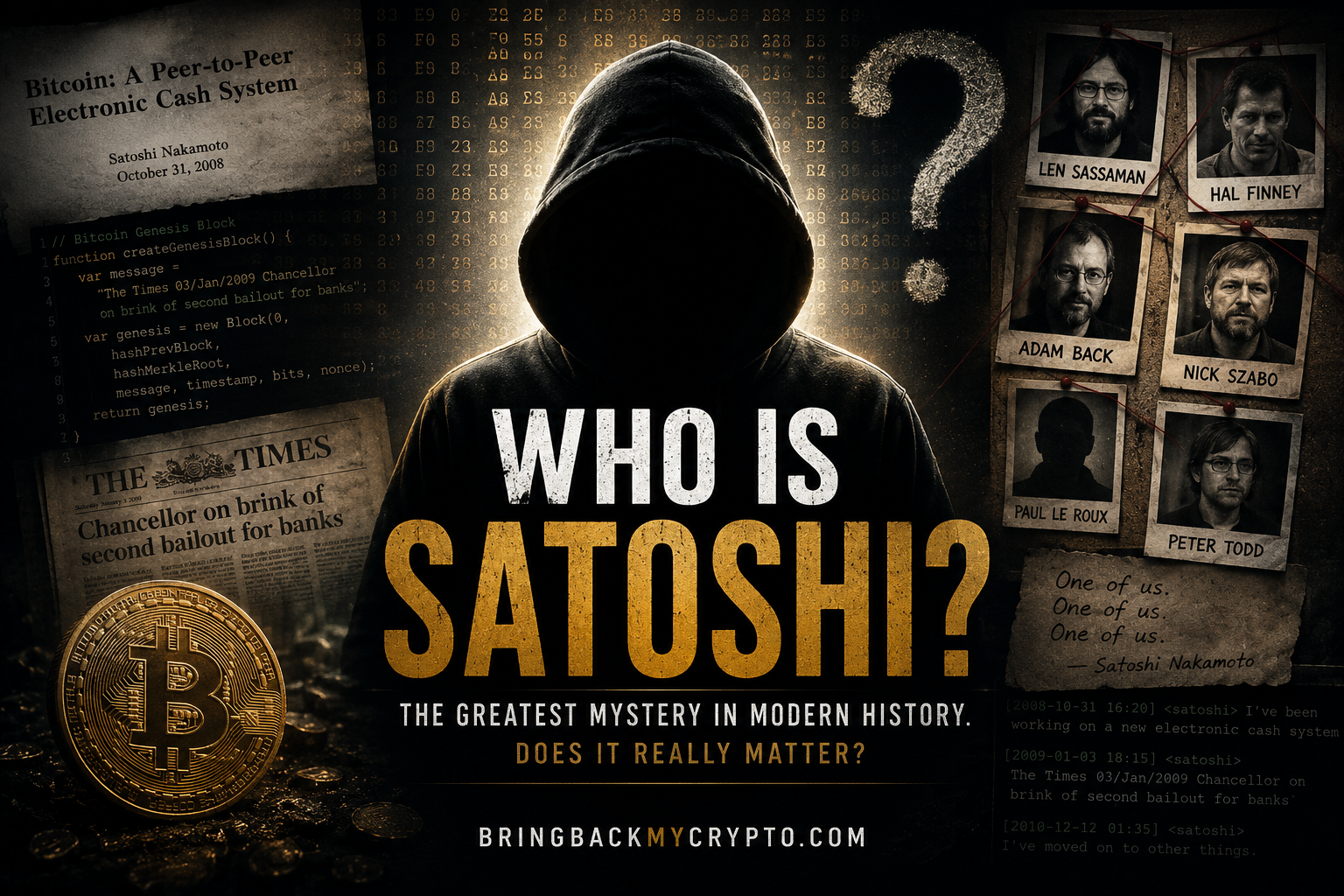
Who Is Satoshi Nakamoto?
A Comprehensive Investigation Into Bitcoin’s Anonymous Creator
Introduction: The Greatest Mystery in Modern Technology
There are very few people in history whose creations transformed:
money,
computer science,
geopolitics,
cryptography,
economics,
energy markets,
and global power structures…
while simultaneously remaining completely anonymous.
Yet that is exactly what happened with Satoshi Nakamoto.
Satoshi Nakamoto:
published the Bitcoin whitepaper in October 2008,
launched the Bitcoin network in January 2009,
communicated publicly for roughly two years,
mined approximately 1 million BTC,
then vanished.
No verified identity.
No confirmed photograph.
No proven nationality.
No definitive fingerprints.
No public spending of the early coins.
No return.
And despite:
governments,
intelligence agencies,
cryptographers,
blockchain analysts,
journalists,
AI stylometry researchers,
and thousands of obsessive internet detectives…
nobody has conclusively identified Satoshi Nakamoto.
This article is a deep forensic exploration of:
who Satoshi might be,
how he covered his tracks,
the leading suspects,
the linguistic clues,
the timing patterns,
the cryptographic fingerprints,
the dormant coins,
and whether discovering his identity would even matter anymore.
We will not attempt to provide a definitive answer.
Because perhaps the greatest trick Satoshi ever performed was ensuring that Bitcoin no longer needs him.
1. The First Appearance of Satoshi Nakamoto
Satoshi first appeared publicly on:
31 October 2008via the Cryptography Mailing List hosted at:
metzdowd.comThe message was concise:
“I've been working on a new electronic cash system that's fully peer-to-peer, with no trusted third party.”
Attached was:
Bitcoin: A Peer-to-Peer Electronic Cash SystemThe now legendary 9-page whitepaper.
What is remarkable is how complete the system already was:
Proof-of-Work
Difficulty adjustment
Double-spend prevention
Incentive alignment
Distributed consensus
Public/private key ownership
Fixed issuance schedule
Timestamped chain architecture
Bitcoin did not emerge as a rough idea. It arrived astonishingly mature.
2. The Intelligence Behind Bitcoin
To create Bitcoin required expertise in all of the following:
Cryptography
Distributed systems
Economics
C++ programming
Game theory
Peer-to-peer networking
Monetary history
Privacy engineering
Security engineering
This immediately narrows the suspect pool dramatically.
Bitcoin was not the work of:
a casual hobbyist,
a finance bro,
or a startup founder.
It was likely built by:
a cypherpunk,
cryptographer,
systems engineer,
or highly technical collective.
3. The Cypherpunk Connection
Bitcoin emerged directly from the cypherpunk movement.
The cypherpunks believed:
privacy is a human right,
cryptography is political power,
centralised systems inevitably become abusive,
mathematics can replace institutional trust.
Prominent cypherpunks included:
Hal Finney
Nick Szabo
Adam Back
Len Sassaman
Wei Dai
Timothy May
Eric Hughes
Bitcoin appears less like an isolated invention and more like: the culmination of decades of cypherpunk evolution.
4. How Satoshi Covered His Tracks
Perhaps the most fascinating aspect of the mystery is not who Satoshi was, but how incredibly disciplined he was operationally.
Satoshi demonstrated near-perfect OPSEC (Operational Security).
5. Email and Identity Isolation
Satoshi used:
anonymous email accounts,
pseudonymous identities,
privacy-conscious hosting,
compartmentalised communication.
No confirmed:
phone number,
physical address,
bank account,
face,
employment record,
social account,
or government identity has ever surfaced.
This is extraordinary considering:
Bitcoin is now worth trillions,
governments globally investigated it,
blockchain analysis has become sophisticated.
6. The Writing Style Analysis
One of the biggest clues is Satoshi’s writing style.
Researchers performed extensive:
stylometric analysis,
punctuation analysis,
lexical pattern analysis,
spelling analysis.
Observed traits:
British English Usage
Satoshi used:
“favour”
“colour”
“optimise”
“maths”
instead of American spellings.
Yet Contradictions Exist
Despite British spelling:
posting times aligned more closely with North American waking hours,
code comments often reflected US programming culture.
Possible explanations:
British/Commonwealth origin
Deliberate linguistic masking
Multi-person collaboration
Educated international background
7. Posting Time Analysis
Researchers mapped Satoshi’s forum posts and emails.
Interesting observation:
Satoshi was almost never active between:
5 AM – 11 AM GMTThis suggested:
sleeping during UK morning hours,
possibly living in North America.
But this may itself have been intentional misdirection.
A truly privacy-conscious creator would absolutely understand metadata analysis.
8. The Genesis Block Message
Bitcoin’s Genesis Block contains the embedded message:
“The Times 03/Jan/2009 Chancellor on brink of second bailout for banks”This accomplished multiple things simultaneously:
1. Timestamp Proof
Proved the block was not mined before that date.
2. Political Statement
Bitcoin emerged directly after the 2008 financial crisis.
3. Monetary Critique
Implicit criticism of:
bank bailouts,
inflationary rescue systems,
centralised monetary power.
This was not merely code. It was philosophy.
9. The Satoshi Coins
Blockchain researchers believe Satoshi mined approximately:
700,000–1,100,000 BTCThese coins remain almost entirely untouched.
At modern prices, this would make Satoshi one of the wealthiest individuals on Earth.
Yet:
the coins remain dormant,
no major liquidation occurred,
no extravagant lifestyle emerged.
This fact alone profoundly affects candidate analysis.
10. Why Haven’t the Coins Moved?
Theories include:
Satoshi died
Lost keys
Ideological (Deliberate non-spending)
Fear (Spending reveals identity)
Imprisoned (Unable to access)
Multiple people (Keys fragmented)
Time-locking (Delayed access mechanisms)
The dormancy itself became one of Bitcoin’s stabilising myths.
11. Candidate #1 — Len Sassaman
Len Sassaman is one of the strongest candidates.
Who Was Len Sassaman?
Sassaman was:
an elite cryptographer,
privacy activist,
cypherpunk contributor,
PGP developer,
remailer expert.
He was deeply embedded within the exact circles Bitcoin emerged from.
Why People Suspect Him
Technical Capability
He unquestionably possessed the required expertise.
Privacy Obsession
His work focused heavily on anonymity systems.
Timing
Sassaman died in:
July 2011Shortly after Satoshi’s final communications. This timing deeply unsettled many researchers.
The Blockchain Obituary
An obituary tribute to Sassaman was embedded into:
Block 138725This is highly unusual.
To many, it feels symbolic.
The 2026 Documentary Theory
The 2026 documentary:
Finding Satoshisuggested:
Satoshi may not have been one individual,
Sassaman and Finney may have collaborated.
This theory attempts to explain:
varying writing styles,
broad expertise,
operational sophistication.
Counterarguments
No direct cryptographic evidence links Sassaman to Bitcoin.
Also:
no early Bitcoin wallet evidence,
no leaked source drafts,
no verified coding overlap.
12. Candidate #2 — Hal Finney
Hal Finney remains perhaps the most beloved suspect.
Who Was Hal Finney?
Finney was:
a legendary cryptographer,
PGP contributor,
cypherpunk,
software engineer.
He received the first Bitcoin transaction ever sent from Satoshi.
Why He Fits
1. Technical Ability
Absolutely sufficient.
2. Writing Style
Some overlap exists.
3. Early Involvement
Finney ran:
the first node,
early testing infrastructure.
4. Geography
He lived near:
Dorian Nakamoto.
Some speculate the “Nakamoto” name was borrowed locally.
The ALS Timeline
Finney developed ALS and died in: 2014
The inactivity of Satoshi’s coins roughly aligns with his declining health.
Why Many Doubt It
Finney publicly denied being Satoshi.
Importantly:
he shared genuine email exchanges,
his coding style differed somewhat,
forensic analysis suggests separate individuals.
Still, some theorise:
he was protecting another person,
he was part of a team,
or he intentionally maintained separation.
13. Candidate #3 — Adam Back
Adam Back became one of the strongest modern candidates.
Why Back Matters
Back created:
Hashcashthe Proof-of-Work system directly cited in the Bitcoin whitepaper.
Without Hashcash:
Bitcoin likely does not exist.
Why People Suspect Him
1. Deep Expertise
He possessed:
cryptographic knowledge,
distributed systems understanding,
anti-spam PoW expertise.
2. Mailing List Presence
Back was active in the exact communities Bitcoin emerged from.
3. Stylometric Similarities
Some analyses found:
linguistic overlap,
similar technical phrasing.
4. 2026 New York Times Investigation
A major investigation reportedly identified Back as among the strongest candidates.
Why It Might Not Be Him
Back consistently denied being Satoshi.
Additionally:
some believe Satoshi appeared too detached from Hashcash’s creator,
email interactions feel authentic rather than staged.
14. Candidate #4 — Nick Szabo
Nick Szabo is perhaps the most academically compelling candidate.
Bit Gold: Bitcoin Before Bitcoin
Szabo created:
Bit Goldyears before Bitcoin.
Bit Gold included:
scarce digital units,
Proof-of-Work,
decentralised concepts,
timestamping ideas.
It was astonishingly close to Bitcoin conceptually.
Stylometry Evidence
Multiple analyses concluded:
Szabo’s writing style most closely resembles Satoshi’s.
This included:
sentence construction,
technical terminology,
punctuation patterns.
The Intellectual Match
Szabo’s writings on:
money,
trust minimisation,
cryptography,
decentralised law,
feel philosophically extremely aligned with Bitcoin.
Counterarguments
No direct coding evidence links him.
Also:
some Bitcoin implementation details seem unlike Szabo’s typical coding style,
he consistently denied involvement.
15. Candidate #5 — Paul Le Roux
Paul Le Roux represents the “dark horse” theory.
Why This Theory Exists
Le Roux:
was an elite programmer,
built encryption software,
possessed extreme intelligence,
later became a global criminal mastermind.
Some theorists argue:
he had capability,
motive,
anti-state tendencies.
The Strange Coincidence
His imprisonment coincides with:
long-term inactivity,
disappearance from public activity.
Problems With the Theory
The personality mismatch is substantial.
Satoshi appeared:
disciplined,
calm,
ideologically focused.
Le Roux appeared:
violent,
impulsive,
empire-driven.
Most researchers view this theory as unlikely.
16. Craig Wright — The Most Famous Failure
Craig Wright publicly claimed to be Satoshi.
For years.
Why Most Experts Rejected Him
Issues included:
forged evidence allegations,
inconsistent technical claims,
cryptographic proof failures,
contradictory timelines.
2024 UK Court Ruling
A UK court concluded:
Wright was not Satoshi,
evidence had been falsified.
This significantly damaged his credibility.
17. Dorian Nakamoto
Dorian Nakamoto became famous after a 2014 article.
The evidence was extraordinarily weak.
The Bitcoin community largely concluded:
mistaken identity,
unfortunate media harassment.
18. Peter Todd
Peter Todd became a candidate following an HBO documentary. The claims were widely criticised as speculative. Todd himself dismissed them as absurd.
19. Was Satoshi a Group?
Increasingly, many researchers believe: “Satoshi Nakamoto” may have been multiple people.
This theory explains:
broad expertise,
linguistic variation,
operational sophistication,
long-term secrecy.
Possible roles:
cryptographer,
economist,
systems programmer,
editor,
operational security specialist.
20. How Satoshi Disappeared So Completely
Satoshi’s disappearance was remarkably disciplined.
He:
gradually reduced communication,
delegated development,
avoided emotional attachment,
never attempted fame,
never monetised identity.
Final known message:
“I’ve moved on to other things.”
Then silence.
No dramatic exit.
No manifesto.
No narcissism.
This is profoundly unusual in modern tech culture.
21. Why Satoshi’s Anonymity May Have Saved Bitcoin
Had Satoshi remained public:
governments could pressure him,
media could personalise Bitcoin,
leadership cults may emerge,
centralisation pressures increase.
Instead:
Bitcoin became:
leaderless,
decentralised,
protocol-driven.
Satoshi’s disappearance may have been Bitcoin’s final decentralisation step.
22. Does It Even Matter Who Satoshi Was?
Philosophically:
perhaps not.
Technically:
perhaps yes.
Economically:
absolutely.
If Satoshi were conclusively identified:
markets would react,
dormant coins could move,
geopolitical implications emerge.
But Bitcoin itself? It would continue.
That may be the greatest achievement of all - a system whose creator became unnecessary.
23. What Happens If Satoshi’s Coins Move?
If early Patoshi-pattern coins moved, markets would likely panic initially.
Questions would explode:
Is Satoshi alive?
Were keys compromised?
Is he selling?
Is Bitcoin at risk?
Yet technically nothing changes.
Consensus rules remain identical.
24. Could Governments Already Know?
A persistent theory suggests:
intelligence agencies may already know.
But proving identity publicly would require:
cryptographic proof,
signed messages,
wallet signatures.
Without private keys, certainty remains elusive.
25. The Ultimate Irony
The world became obsessed with:
“Who created Bitcoin?”
while simultaneously missing Bitcoin’s core message:
systems should not require trusted individuals.
Bitcoin’s architecture deliberately removes:
rulers,
founders,
gatekeepers.
Perhaps Satoshi understood, the creator had to disappear for the creation to survive.
Final Thoughts
The mystery of Satoshi Nakamoto may never be solved.
And perhaps that is fitting.
Whether Satoshi was:
Len Sassaman,
Hal Finney,
Adam Back,
Nick Szabo,
a team,
or someone entirely unknown…
the identity ultimately matters less than the system itself.
Bitcoin survived:
his disappearance,
bans,
hacks,
exchange collapses,
government hostility,
media attacks,
internal wars.
That resilience may itself be Satoshi’s true identity, not a person, but an idea.
And somewhere, perhaps:
in a forgotten encrypted drive,
behind a lost passphrase,
inside a dormant wallet.dat,
or beneath layers of carefully constructed anonymity the greatest digital fortune in history still waits silently. Untouched.