Introduction
Every four years, Bitcoin undergoes one of the most important monetary events in modern financial history: the Bitcoin Halving.
Unlike fiat currencies, where central banks can alter money supply at will, Bitcoin follows a mathematically enforced issuance schedule embedded directly into the protocol by its creator, Satoshi Nakamoto.
The halving is the mechanism that ensures Bitcoin’s scarcity.
It reduces the amount of new BTC entering circulation and progressively decreases inflation until the maximum supply of 21 million coins is eventually reached around the year 2140.
To casual observers, the halving may appear to be simply a reduction in mining rewards.
In reality, it is far more significant.
The halving affects:
Miner economics
Global hash rate
Market psychology
Bitcoin scarcity
Security assumptions
Transaction fee markets
Energy economics
Hardware development
Long-term protocol sustainability
At BringBackMyCrypto.com, understanding the halving is critical because it directly impacts:
Long-term wallet value
Dormant wallet recovery incentives
Mining-era wallet structures
Security models
Historic key generation practices
The economics of lost Bitcoin
This article provides a deep technical exploration of how the Bitcoin halving works and why it remains one of the most revolutionary monetary mechanisms ever created.
1. What Is the Bitcoin Halving?
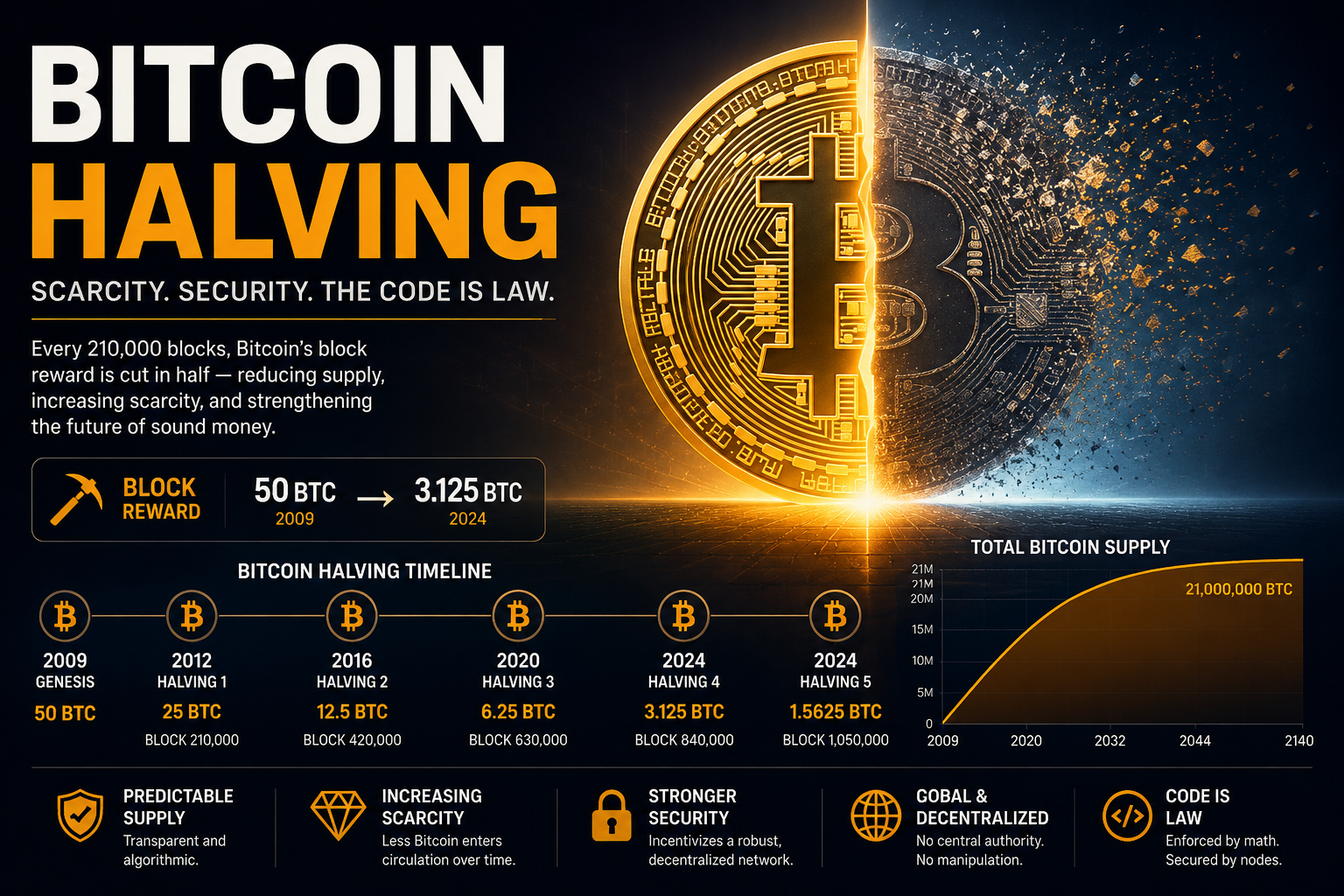
The Bitcoin halving is a protocol event that reduces the block subsidy awarded to miners by 50% every 210,000 blocks.
Since blocks are mined approximately every 10 minutes, halvings occur roughly every:
210,000 × 10 minutes
≈ 4 years
The block subsidy began at:
50 BTC per blockand is reduced according to:
50 → 25 → 12.5 → 6.25 → 3.125 ...This process continues until the subsidy effectively reaches zero.
2. Why the Halving Exists
Bitcoin’s monetary policy was designed to solve a core problem of fiat money:
Unlimited monetary expansion.
Traditional central banking systems can increase money supply through:
Quantitative easing
Debt monetisation
Fractional reserve expansion
Emergency liquidity injections
Bitcoin rejects this entirely.
Instead, Bitcoin implements:
Predictable issuance
Fixed supply
Transparent inflation
Immutable monetary rules
The halving is the mechanism that enforces this scarcity.
3. Bitcoin’s Issuance Schedule
Bitcoin issuance follows a geometric decay curve.
Halving Timeline
EraBlock RewardApprox DatesEra 050 BTC2009–2012Era 125 BTC2012–2016Era 212.5 BTC2016–2020Era 36.25 BTC2020–2024Era 43.125 BTC2024–2028
The formula for total supply converges toward:
21,000,000 BTCThis is enforced mathematically by the consensus rules.
No government, miner, developer, or corporation can arbitrarily increase it without a network-wide consensus fork.
4. The Mathematics Behind the Halving
Bitcoin supply follows a finite geometric series.
The total issuance can be expressed as:
210000 × 50 +
210000 × 25 +
210000 × 12.5 +
...
This simplifies to:
210000 × 50 × (1 + 1/2 + 1/4 + 1/8 ...)Since:
1 + 1/2 + 1/4 + ...
= 2
Then:
210000 × 50 × 2
= 21,000,000
This elegant mathematical structure guarantees scarcity.
5. How the Halving Works Inside Bitcoin Core
The halving is enforced at consensus level.
Inside Bitcoin Core, the subsidy calculation resembles:
CAmount GetBlockSubsidy(int nHeight, const Consensus::Params& consensusParams)
{
    int halvings = nHeight / consensusParams.nSubsidyHalvingInterval;

    if (halvings >= 64)
        return 0;

    CAmount nSubsidy = 50 * COIN;
    nSubsidy >>= halvings;

    return nSubsidy;
}
Key Observations
1. Integer Bit Shift
The operator:
nSubsidy >>= halvings;performs binary right-shifting, effectively dividing by 2 repeatedly.
2. Consensus Critical
Every full node independently validates:
Correct subsidy
Correct block reward
Correct issuance amount
A miner attempting to create excess BTC would have the block rejected instantly.
6. The Role of Miners
Miners secure Bitcoin by:
Validating transactions
Building blocks
Performing Proof-of-Work
Competing for block rewards
Their compensation consists of:
Block Reward = Subsidy + Transaction FeesInitially, almost all miner revenue came from the subsidy.
Over time:
Subsidy decreases
Fee revenue becomes more important
This transition is fundamental to Bitcoin’s long-term design.
7. The Halving and Bitcoin Security
A common misunderstanding is:
“Reducing rewards weakens security.”
The reality is more nuanced.
Bitcoin security depends on:
Hash rate
Miner profitability
BTC price
Energy efficiency
Fee market development
After a halving:
Some inefficient miners shut down
Difficulty adjusts downward
More efficient miners survive
Competition rebalances
Historically, Bitcoin’s security has remained robust after every halving.
8. Difficulty Adjustment: The Self-Correcting Mechanism
Bitcoin includes an automatic difficulty adjustment every:
2016 blocks ≈ 2 weeksIf miners leave after a halving:
Block production slows temporarily
Difficulty decreases
Mining becomes easier
Equilibrium returns
This is one of Bitcoin’s most ingenious engineering features.
9. The Halving and Scarcity
Bitcoin’s scarcity model differs radically from fiat currencies and commodities.
Gold
More can always be mined
Supply expands with technology
Fiat Currency
Infinite theoretical supply
Politically controlled
Bitcoin
Fixed issuance schedule
Transparent inflation
Immutable supply cap
The halving progressively reduces inflation toward zero.
10. Bitcoin Stock-to-Flow Dynamics
The halving dramatically increases Bitcoin’s:
Stock-to-flow ratio
Monetary hardness
Scarcity profile
Stock
Existing BTC supply.
Flow
New BTC produced annually.
After each halving:
Flow decreases
Scarcity increases
This is why many investors compare Bitcoin to:
Digital gold
Monetary energy
Hard money
11. Historical Halvings
2012 Halving
Reward:
50 → 25 BTCBTC price near halving:
~$12This marked Bitcoin’s transition from experimental technology to emerging asset.
2016 Halving
Reward:
25 → 12.5 BTCMajor themes:
Industrial mining expansion
ASIC dominance
Institutional awareness
2020 Halving
Reward:
12.5 → 6.25 BTCOccurred during:
Global monetary expansion
Pandemic-era QE
Institutional adoption phase
Bitcoin increasingly became viewed as:
Inflation hedge
Treasury reserve asset
2024 Halving
Reward:
6.25 → 3.125 BTCThis era introduced:
Spot Bitcoin ETFs
Large institutional inflows
Fee spikes from Ordinals and inscriptions
Increased discussion around long-term fee markets
12. ASIC Mining and the Halving
Mining hardware evolved dramatically because of halvings.
Era 1 : CPU Mining
Era 2 : GPU Mining
Era 3: FPGA Mining
Era 4: ASIC Mnining
As rewards decrease:
Efficiency becomes critical
Electricity costs dominate
Economies of scale matter more
Modern ASICs perform:
100+ TH/swith vastly superior efficiency compared to early miners.
13. Energy Economics After Halvings
After each halving:
Revenue per block decreases
Energy efficiency becomes essential
This drives:
Renewable energy usage
Stranded energy utilisation
Flared gas mining
Hydro-powered facilities
The economics naturally push miners toward the cheapest energy globally.
14. Fee Markets: Bitcoin’s Future Security Model
Eventually, subsidies become negligible.
Bitcoin’s long-term security model relies increasingly on:
Transaction fees
High-value settlement demand
Layer-2 scaling
This transition is gradual and expected.
The key assumption:
Bitcoin block space becomes increasingly valuable.
15. The Halving and Lost Bitcoin
Millions of BTC are believed permanently lost.
Causes include:
Forgotten passwords
Lost hardware wallets
Destroyed drives
Corrupted wallets
Inaccessible seed phrases
At BringBackMyCrypto.com, we frequently analyse wallets originating from:
Early mining eras
Pre-halving accumulation periods
Legacy wallet.dat structures
Dormant addresses untouched since prior halvings
Because issuance decreases every four years:
Lost BTC becomes increasingly significant
Effective circulating supply may be far below 21 million
This further intensifies scarcity.
16. Psychological Effects of the Halving
The halving has become one of the most closely watched events in crypto markets.
Why?
Because it creates:
Predictable supply shocks
Narrative reinforcement
Increased media attention
Miner positioning changes
Unlike traditional markets, Bitcoin’s issuance changes are:
Transparent
Anticipated years in advance
Impossible to manipulate politically
17. Common Misconceptions About the Halving
“The halving guarantees price increases.”
False.
Price depends on:
Demand
Liquidity
Macro conditions
Market structure
The halving only changes supply issuance.
“Bitcoin becomes insecure after subsidies fall.”
Not necessarily.
Fee markets and price appreciation can offset subsidy reductions.
“Miners control Bitcoin.”
Incorrect.
Full nodes enforce consensus rules.
Miners cannot:
Increase supply
Change halving schedule
Rewrite protocol rules arbitrarily
18. The Final Bitcoin Will Never Truly Be Mined
Due to integer rounding:
The subsidy eventually becomes smaller than 1 satoshi
Rewards terminate naturally
The final fractions of BTC issuance occur extremely slowly.
The last meaningful subsidy is expected near:
214019. Why the Halving Is Revolutionary
The Bitcoin halving represents something humanity has never previously experienced:
A globally distributed monetary system with immutable issuance rules enforced entirely by mathematics and consensus.
There is:
No central bank
No monetary committee
No emergency printing
No political override
Bitcoin transforms monetary policy into software.
20. Halving Cycles and Long-Term Bitcoin Survivability
The halving mechanism creates:
Declining inflation
Increasing scarcity
Long-term economic discipline
Most importantly:
It aligns incentives across decades
Bitcoin miners, developers, node operators, and users all interact within a system whose monetary rules are:
Transparent
Predictable
Extremely difficult to alter
This long-term stability is one reason Bitcoin remains uniquely resilient.
21. The Halving and Recovery Forensics
At BringBackMyCrypto.com, halvings often provide clues during investigations.
Wallets from different eras exhibit:
Different address formats
Different encryption methods
Different mining patterns
Different transaction fee assumptions
Different wallet software structures
For example:
Early 50 BTC coinbase rewards often indicate solo CPU mining
Legacy wallets may predate HD seed standards
Early miners frequently used weak passwords or reused credentials
Understanding halving eras can therefore assist:
Wallet dating
Key reconstruction strategies
Mining-era attribution
Blockchain forensic analysis
Conclusion
The Bitcoin halving is far more than a reduction in mining rewards.
It is:
A monetary policy engine
A scarcity mechanism
A security balancing system
A global economic experiment
A cryptographic enforcement model
Every halving pushes Bitcoin further toward:
Absolute scarcity
Fee-market maturity
Institutional significance
Long-term monetary independence
Whether viewed through the lens of:
Cryptography
Economics
Security engineering
Game theory
Monetary history
the halving remains one of the most remarkable innovations in modern finance.
At BringBackMyCrypto.com, understanding these mechanisms is critical not only for protecting Bitcoin—but also for recovering and preserving it for future generations.
As halvings continue and supply issuance declines, accessible Bitcoin becomes increasingly scarce.
Which means:
Every lost wallet matters more
Every recoverable key becomes more valuable
Every forgotten password could represent a significant digital fortune
And that is why Bitcoin recovery, forensic analysis, and long-term wallet security will only become more important in the decades ahead.