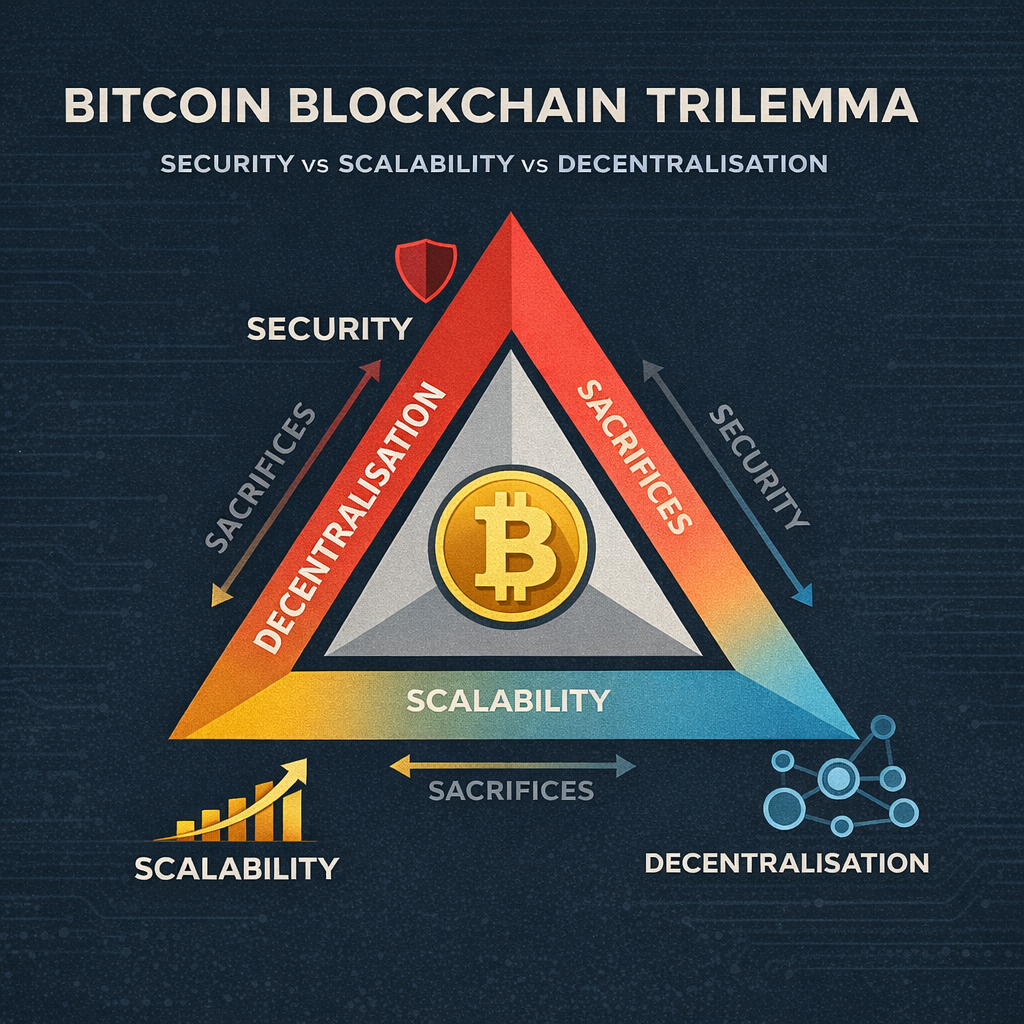
The Bitcoin Blockchain Trilemma
Why Bitcoin deliberately chooses “slow and hard” over “fast and fragile”
Introduction
In blockchain engineering, few concepts are as fundamental or as misunderstood as the Blockchain Trilemma.
The trilemma states that a distributed ledger system can optimise for only two of the following three properties at any one time:
Security
Scalability
Decentralisation
Attempting to maximise all three simultaneously results in trade-offs that weaken at least one dimension.
Bitcoin’s design makes a clear, intentional choice:
Security and decentralisation come first. Scalability is secondary.
This is not a flaw it is a design philosophy rooted in cryptography, game theory, and adversarial threat modelling.
At BringBackMyCrypto.com, understanding this trilemma is essential when analysing:
Wallet security failures
Protocol limitations
Custodial risk
Layer-2 architectures
Why “faster blockchains” often sacrifice trustlessness
Why Bitcoin remains uniquely recoverable and auditable even after 15+ years
1. Defining the Trilemma Components
1.1 Security
In Bitcoin, security means:
Resistance to double-spending
Immutability of confirmed transactions
Economic cost to rewrite history
Resistance to censorship and protocol manipulation
Cryptographic soundness (ECDSA / Schnorr, SHA-256)
Robustness against state-level adversaries
Security is enforced through:
Proof-of-Work (PoW)
Global hash competition
Longest-chain consensus
Deterministic validation rules
Full-node verification
Security is non-negotiable. If Bitcoin becomes insecure, it becomes worthless.
1.2 Scalability
Scalability answers one question:
How many transactions per second can the network process without failure?
Bitcoin base layer characteristics:
~7 transactions per second
~10 minute block interval
~1–4 MB effective block size
Global propagation latency
This is intentionally constrained.
Bitcoin does not attempt Visa-scale throughput at Layer 1 because doing so would:
Increase hardware requirements
Reduce node participation
Centralise validation
Increase attack surface
Undermine self-sovereignty
1.3 Decentralisation
Decentralisation means:
Anyone can run a full validating node
No privileged validators
No central scheduler
No leader election cartel
No trusted third parties
Consensus enforced by users, not miners
Bitcoin decentralisation is expressed through:
Tens of thousands of independently operated nodes
Permissionless mining
Open-source consensus rules
Fork resistance through social consensus
Decentralisation is the enforcer of Bitcoin’s rules.
2. Why the Trilemma Exists (A Systems Perspective)
The trilemma arises due to physical and economic constraints, not ideology.
Bandwidth Constraint
Every full node must:
Receive blocks
Verify scripts
Validate signatures
Store the full chain
Increasing throughput increases:
Bandwidth usage
Disk requirements
CPU load
Memory pressure
This excludes users with modest hardware leading to centralisation.
Latency Constraint
Bitcoin is global.
Propagation delay between continents is measured in hundreds of milliseconds.
Large blocks increase orphan risk and incentivise:
Mining pools
Block relay cartels
Private mempools
Game-Theoretic Constraint
If validation becomes expensive:
Users outsource verification
Custodians emerge
“Trust me” replaces “verify”
This is how decentralisation dies.
3. Bitcoin’s Explicit Trilemma Choice
Bitcoin optimises for:
✅ Security
✅ Decentralisation
❌ Base-layer Scalability
This is not accidental.
Satoshi Nakamoto’s design ensures that:
Verification is cheap
Attack is expensive
Consensus rules are rigid
History is extremely costly to rewrite
Bitcoin treats Layer 1 as a settlement layer, not a retail payment rail.
4. Proof-of-Work: Why Security Is Expensive on Purpose
Bitcoin security is backed by real-world energy.
Proof-of-Work provides:
Objective cost
Unforgeable history
Externalised attack expense
Resistance to “cheap consensus”
To attack Bitcoin, an adversary must:
Acquire massive hashing power
Sustain it for long durations
Compete against honest miners
Lose money continuously
Be visible in real time
This makes large-scale attacks economically irrational.
5. Scalability Without Sacrificing the Base Layer
Bitcoin scales vertically and off-chain, not by bloating Layer 1.
Layer-2 Solutions
Lightning Network
State channels
Sidechains
Ark
Fedimint (trade-off aware)
Key principle:
Do not change Layer-1 trust assumptions
Layer-2 systems inherit Bitcoin’s security only if users can exit unilaterally.
6. The Trilemma and Wallet Recovery
From a recovery and forensic perspective, Bitcoin’s trilemma choice is a feature.
Because Bitcoin is:
Deterministic
Auditable
Non-mutable
Fully verifiable
We can:
Reconstruct wallet histories
Validate old UTXOs
Interpret legacy scripts
Recover funds decades later
Analyse time-locked outputs
Decode partially signed transactions
This is not possible on opaque, mutable, or centrally governed ledgers.
Bitcoin’s “slow” design is why recovery remains possible long after keys are lost.
7. Why Bitcoin Refuses to “Optimise” the Trilemma Away
The trilemma cannot be solved it can only be balanced.
Bitcoin chooses:
Fewer transactions
Higher assurance
Maximum auditability
Minimal trust
Every proposal that claims to “fix” Bitcoin by increasing throughput must answer one question:
Who loses the ability to independently verify?
If the answer is:
Users
Home nodes
Non-custodial wallets
Then Bitcoin has already lost.
8. Summary: Bitcoin’s Trilemma in One Sentence
Bitcoin sacrifices base-layer speed so that anyone, anywhere, can independently verify the entire monetary system without permission.
That is the trade-off.
That is the point.
Final Thoughts
Bitcoin’s blockchain trilemma is not a limitation it is a security boundary.
It ensures that:
Funds cannot be frozen
History cannot be rewritten
Validation cannot be outsourced
Recovery remains possible
Sovereignty is preserved
At BringBackMyCrypto.com, we work with Bitcoin precisely because it refuses to compromise on these fundamentals.
If you are interacting with Bitcoin systems whether for storage, inheritance, recovery, or protocol research understanding the trilemma is essential.