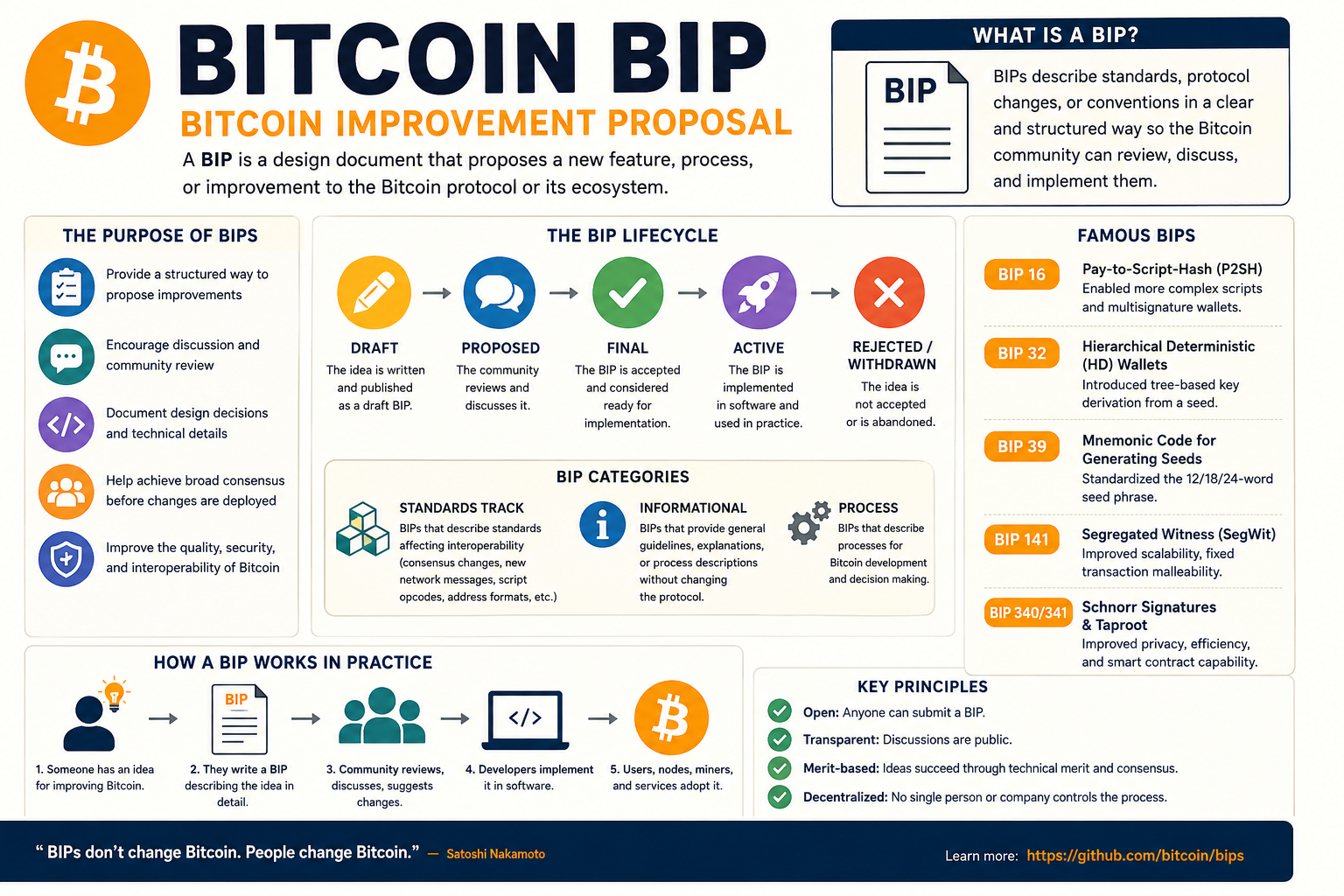
The Bitcoin Improvement Proposal
Introduction
When most people think about Bitcoin, they think about mining, wallets, private keys, halvings, and perhaps the mysterious figure of Satoshi Nakamoto. Yet behind every major change to Bitcoin lies a less glamorous but incredibly important system known as the Bitcoin Improvement Proposal, or BIP.
Without BIPs, there would be no SegWit, no Taproot, no HD wallets, no mnemonic seed phrases, no Lightning Network standards, and arguably no organised method for Bitcoin's technical evolution.
BIPs are the closest thing Bitcoin has to a constitution, a parliament, and an engineering specification rolled into one. They are not laws. They are not commands. They do not force anyone to do anything. Instead, they provide a structured framework for proposing, discussing, documenting, and ultimately implementing changes to the Bitcoin protocol and its surrounding ecosystem.
This article takes a deep technical dive into the history, mechanics, successes, failures, politics, and future of the BIP process.
The Origins of BIPs
Before BIPs
In Bitcoin's earliest years (2009-2011), development was relatively informal.
Bitcoin was tiny.
Most developers communicated directly with Satoshi Nakamoto through:
Bitcointalk
IRC channels
Email exchanges
Source code comments
If someone wanted to suggest a protocol change, there was no formal procedure. Discussions occurred in forum threads, mailing lists, and GitHub commits.
This worked while Bitcoin was small.
It became increasingly problematic as the ecosystem grew.
Developers needed:
Formal documentation
Historical records
Standardisation
Review processes
Consensus mechanisms
A better system was needed.
The Creation of BIPs
The BIP system was inspired by Python's successful PEP (Python Enhancement Proposal) process.
The formal BIP framework was introduced by:
Amir Taaki
in 2011.
Taaki authored:
BIP 0001 – BIP Purpose and Guidelines
which remains the foundational document governing all future BIPs.
BIP 1 defined:
Proposal format
Review process
Numbering system
Responsibilities
Lifecycle states
Essentially, BIP 1 created a structured engineering process for Bitcoin.
The irony is fascinating:
Bitcoin is designed to be decentralised, yet its evolution required an organised documentation system.
BIPs became that system.
What Exactly Is a BIP?
A BIP is simply a design document.
Think of it as:
A technical specification describing a proposed change to Bitcoin.
A BIP may:
Change consensus rules
Add wallet functionality
Improve peer-to-peer networking
Standardise transaction formats
Define best practices
Importantly:
A BIP itself changes nothing.
Only software adoption changes Bitcoin.
A BIP is merely documentation.
Types of BIPs
Bitcoin classifies BIPs into three broad categories.
1. Standards Track BIPs
These directly affect interoperability.
Examples include:
Consensus changes
Transaction formats
Block validation rules
Networking protocols
Examples:
BIP 16 (P2SH)
BIP 34
BIP 66
BIP 141 (SegWit)
BIP 340 (Schnorr)
BIP 341 (Taproot)
These are often the most controversial.
2. Informational BIPs
These provide guidance but do not change protocol rules.
Examples:
Explanations
Research
Best practices
Informational BIPs are often educational.
3. Process BIPs
These govern Bitcoin's development process itself.
Examples:
BIP 1
Governance procedures
Deployment methods
Think of these as "meta-BIPs."
The Lifecycle of a BIP
A BIP follows a defined lifecycle.
Draft
Initial proposal.
The author writes the specification.
Discussion begins.
Most BIPs never leave this stage.
Proposed
The BIP gains traction.
Developers begin serious review.
Implementation may begin.
Final
The proposal is widely accepted and implemented.
No further changes expected.
Rejected
The community rejects the idea.
Withdrawn
The author voluntarily abandons it.
Deferred
Interesting idea, wrong time.
Active
Ongoing process BIPs that remain relevant indefinitely.
How Consensus Actually Works
Many newcomers imagine that Bitcoin Core developers vote.
They do not.
There is no parliament.
No board of directors.
No CEO.
Instead, consensus emerges from multiple stakeholders:
Developers
Write code.
Miners
Produce blocks.
Node Operators
Validate blocks.
Exchanges
Provide liquidity.
Businesses
Build services.
Users
Choose software.
Ultimately:
Consensus is software adoption.
A BIP succeeds only when enough of the ecosystem voluntarily implements it.
Famous BIPs That Changed Bitcoin Forever
BIP 16 : Pay-to-Script-Hash (P2SH)
Author:
Gavin Andresen
Introduced in 2012.
Before P2SH:
Complex scripts were difficult to use.
P2SH introduced addresses beginning with:
3
Example:
3J98t1WpEZ73CNmQviecrnyiWrnqRhWNLy
Benefits:
Multisig adoption
Reduced complexity
Better usability
This BIP laid the foundation for modern multisignature wallets.
BIP 32 : Hierarchical Deterministic Wallets
Author:
Pieter Wuille
One of the most important BIPs ever written.
Before BIP32:
Users had to back up every private key.
Disaster.
BIP32 introduced:
master seed
↓
master key
↓
child keys
↓
addresses
Now:
One seed generates millions of keys.
Every modern wallet depends on this.
BIP 39 : Mnemonic Seed Phrases
Author:
Marek Palatinus and others.
Introduced the famous:
abandon
ability
able
about
above
absent
...
word lists.
Examples:
12 words
18 words
24 words
BIP39 became the de facto wallet backup standard.
Ironically, it was never advanced beyond "Proposed."
Yet it became one of Bitcoin's most widely adopted standards.
This demonstrates a crucial lesson:
BIP status does not guarantee adoption.
Adoption determines success.
BIP 44
Built on BIP32.
Introduced:
m/44'/0'/0'/0/0
derivation paths.
Today almost every wallet uses BIP44 or one of its descendants.
BIP 66
Strict DER signature enforcement.
Sounds boring.
Actually critical.
Prevented transaction malleability edge cases.
Strengthened network security.
BIP 68, 112 and 113
Together these introduced:
Relative timelocks.
These eventually enabled:
Lightning Network
Payment channels
Advanced smart contracts
Without these BIPs:
Lightning likely never happens.
SegWit: The Most Famous BIP War
BIP 141
Author:
Pieter Wuille
Introduced:
Segregated Witness (SegWit)
This became one of the largest governance battles in Bitcoin history.
The Problem
Bitcoin blocks were limited.
Transaction malleability existed.
Scaling concerns were growing.
Fees were increasing.
The Solution
SegWit moved signature data into a separate structure.
Benefits:
Effective block capacity increase
Fixed transaction malleability
Enabled Lightning
Better efficiency
Why It Became Controversial
Some wanted:
Larger blocks
Others wanted:
SegWit
This escalated into:
The Blocksize War.
One of the most dramatic periods in Bitcoin history.
BIP 148
User Activated Soft Fork (UASF).
An extraordinary moment.
Users effectively told miners:
Upgrade or be left behind.
The success of BIP148 demonstrated something profound:
Users ultimately control Bitcoin.
Not miners.
Not developers.
Not corporations.
Taproot
BIP 340
Schnorr Signatures
BIP 341
Taproot
BIP 342
Tapscript
Activated in 2021.
Authors included:
Pieter Wuille
Jonas Nick
Anthony Towns
Taproot represented Bitcoin's largest upgrade since SegWit.
Benefits:
Better privacy
Better multisig efficiency
Smaller transactions
Advanced scripting possibilities
Many believe Taproot will become increasingly important over the next decade.
Famous Failed BIPs
Not every BIP succeeds.
BIP 100
Authored by:
Jeff Garzik
Attempted to give miners control over block size.
Strong opposition emerged.
Never adopted.
BIP 101
Authored by:
Gavin Andresen
Massively increased block size.
Eventually became associated with Bitcoin XT.
Rejected by consensus.
BIP 300
Drivechains.
Author:
Paul Sztorc
Proposed sidechains secured by Bitcoin miners.
Still debated years later.
Neither fully accepted nor entirely dead.
A perfect example of a controversial long-running BIP.
Why Most BIPs Fail
Most proposals never become Bitcoin.
Reasons include:
Technical flaws
Hidden vulnerabilities emerge.
Economic concerns
Creates bad incentives.
Complexity
Too difficult to audit.
Political resistance
Stakeholders disagree.
Lack of need
Problem not important enough.
Bitcoin is deliberately conservative.
Failure is normal.
The Hidden Politics of BIPs
Bitcoin has no government.
Yet politics exists.
Every major BIP involves competing interests.
Examples:
Miners may want:
More fees
More influence
Users may want:
Lower fees
Better privacy
Developers may prioritise:
Security
Simplicity
Businesses may prioritise:
Scalability
The BIP process is where these tensions become visible.
Why Bitcoin Changes So Slowly
Many outsiders complain:
Bitcoin development is too slow.
Bitcoin developers consider this a feature.
Changing Bitcoin is like changing the engine of an aircraft while flying.
Mistakes could affect:
Hundreds of billions of dollars
Nation-state reserves
Corporate treasuries
Individual savings
Extreme conservatism is rational.
Soft Forks vs Hard Forks
Many BIPs involve forks.
Soft Fork
New rules are stricter.
Old nodes still function.
Examples:
SegWit
Taproot
Preferred by Bitcoin developers.
Hard Fork
New rules are incompatible.
Everyone must upgrade.
Examples outside Bitcoin:
Ethereum after DAO
Bitcoin Cash split
Bitcoin generally avoids hard forks whenever possible.
The Future of BIPs
The next decade may produce BIPs relating to:
Quantum Resistance
Potential post-quantum signatures.
Examples include discussions surrounding proposals such as BIP361.
Covenants
Long-debated functionality.
Examples:
OP_CHECKTEMPLATEVERIFY
OP_VAULT
These could dramatically improve self-custody security.
Better Privacy
Future cryptographic improvements.
More Efficient Signatures
Reducing block space usage.
Layer 2 Scaling
Lightning enhancements.
Sidechains.
State channels.
Criticisms of the BIP Process
Despite its success, critics argue:
Too slow
Innovation delayed.
Too conservative
Useful ideas rejected.
Developer influence
Some believe Core developers have disproportionate power.
Complexity
Review process difficult for newcomers.
These criticisms are not entirely wrong.
However, supporters argue that Bitcoin's stability is a direct result of this conservatism.
Conclusion
Bitcoin Improvement Proposals are arguably the most important documents in Bitcoin outside the whitepaper itself.
Every major advancement in Bitcoin's history has passed through the BIP process.
They are the mechanism through which ideas become standards, standards become software, and software becomes consensus.
The brilliance of the BIP system is that it balances structure with decentralisation. Anyone can write a BIP. Nobody can force one into Bitcoin.
The history of BIPs tells the history of Bitcoin itself:
The birth of multisig through BIP16
The rise of HD wallets through BIP32
The standardisation of seed phrases through BIP39
The scaling wars surrounding BIP141
The privacy improvements of BIP340-342
The ongoing debates over future innovations
In a network with no king, no president, no headquarters, and no central authority, BIPs provide the language through which Bitcoin evolves.
Understanding BIPs is therefore not merely understanding software development.
It is understanding how the world's first truly decentralised monetary network changes without anyone being in charge.